
Question 4:
Encik Ahmad measured the time taken by five pupils in a 400 m run. Table 2 shows the recorded time.
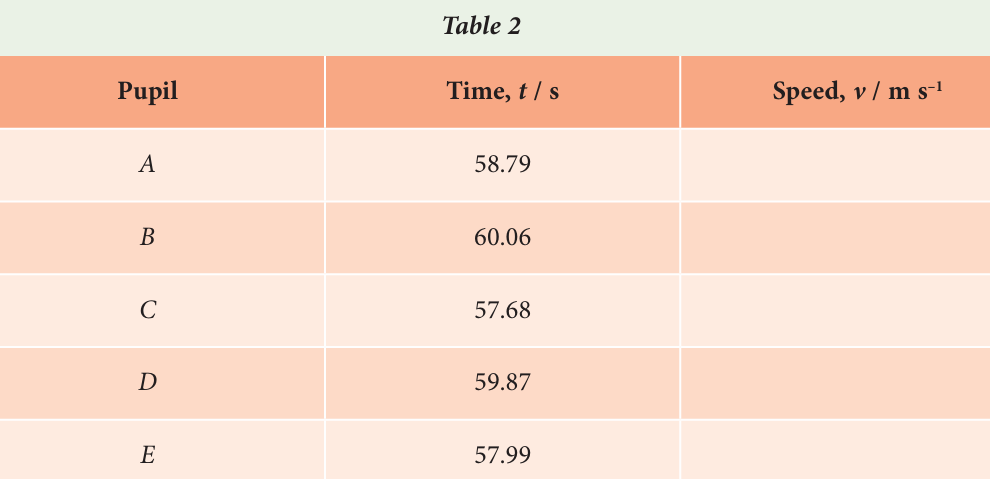
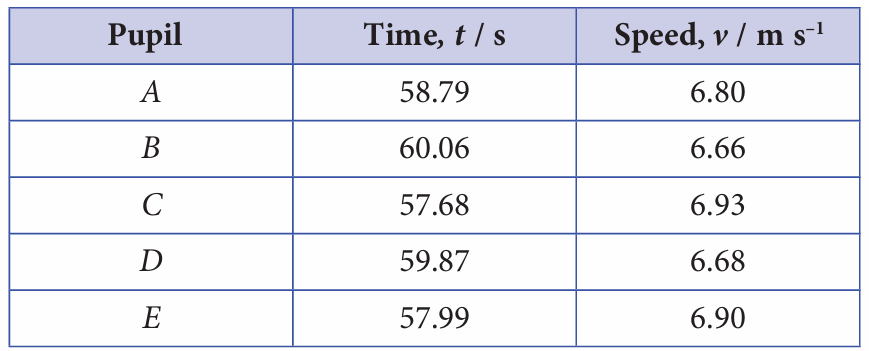
(a) Complete the table by calculating the speed of the five pupils.
(b) Suggest an appropriate device that Encik Ahmad can use in this situation.
(c) Based on the data in Table 2, which pupil is the fastest runner?
(d) State one way to increase the accuracy of the recorded time.
Answer:
(a)
(b) Use an electronic stopwatch to measure the time of their motion.
(c) Pupil C is the fastest.
(d) Use an electronic sensor to prevent errors in measurement caused by the reaction time of humans when starting and stopping the stopwatch.
Encik Ahmad measured the time taken by five pupils in a 400 m run. Table 2 shows the recorded time.
(a) Complete the table by calculating the speed of the five pupils.
(b) Suggest an appropriate device that Encik Ahmad can use in this situation.
(c) Based on the data in Table 2, which pupil is the fastest runner?
(d) State one way to increase the accuracy of the recorded time.
Answer:
(a)
(b) Use an electronic stopwatch to measure the time of their motion.
(c) Pupil C is the fastest.
(d) Use an electronic sensor to prevent errors in measurement caused by the reaction time of humans when starting and stopping the stopwatch.
Question 5:
Table 3 shows the formula for three physical quantities.
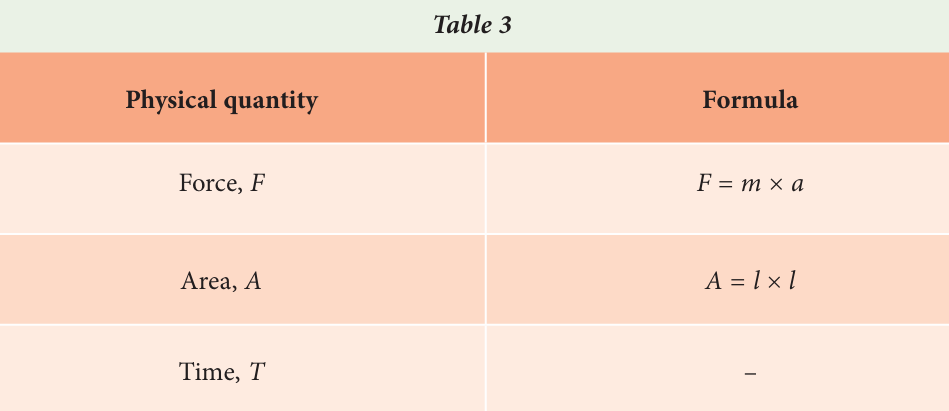
(a) If force, F, area, A and time, T are chosen as new base quantities, then the mass, m and length, l become new derived quantities. State the mass, m and length, l in terms of F, A and T.
(b) What are the constraints faced by physicists if FAT is made as a new basic physical quantity?
Answer:
(a)
$$ \text { In the old system, } \begin{aligned} F & =m l t^{-2} \\ m & =F t^2 l^{-1} \end{aligned} $$
$$ \begin{aligned} &\text { Therefore, in FAT system }\\ &\begin{aligned} l & =A^{1 / 2}, \text { and } \\ m & =F T^2 l^{-1} \\ & =F T^2 A^{-1 / 2} \end{aligned} \end{aligned} $$
(b)
– No measuring instrument can measure force and area accurately.
– No instrument or object is used as standards for force and area.
– Units for derived quantity become very complex and hinder effective communication among physicists.
Table 3 shows the formula for three physical quantities.
(a) If force, F, area, A and time, T are chosen as new base quantities, then the mass, m and length, l become new derived quantities. State the mass, m and length, l in terms of F, A and T.
(b) What are the constraints faced by physicists if FAT is made as a new basic physical quantity?
Answer:
(a)
$$ \text { In the old system, } \begin{aligned} F & =m l t^{-2} \\ m & =F t^2 l^{-1} \end{aligned} $$
$$ \begin{aligned} &\text { Therefore, in FAT system }\\ &\begin{aligned} l & =A^{1 / 2}, \text { and } \\ m & =F T^2 l^{-1} \\ & =F T^2 A^{-1 / 2} \end{aligned} \end{aligned} $$
(b)
– No measuring instrument can measure force and area accurately.
– No instrument or object is used as standards for force and area.
– Units for derived quantity become very complex and hinder effective communication among physicists.
Question 6:
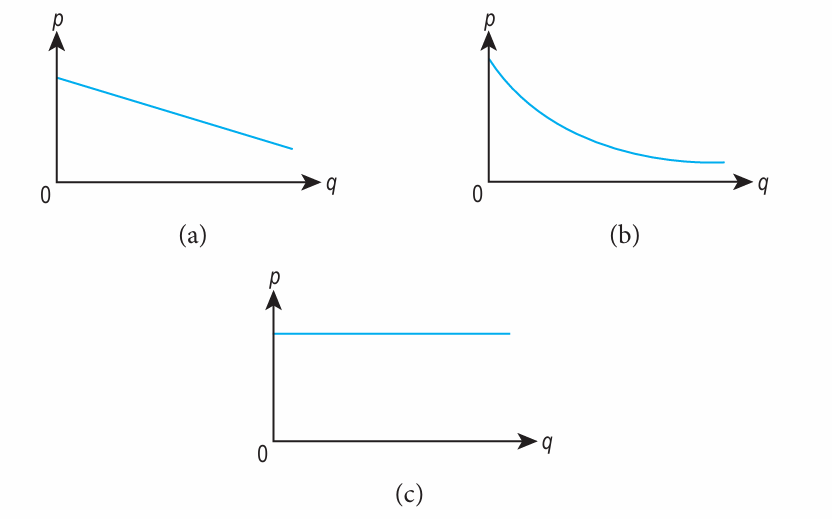
Figure 3 shows graphs obtained from several experiments. Based on the shape of each graph, determine the relationship between the two physical quantities, p and q.
Answer:
(a) – Straight line that does not pass through the origin and has a negative gradient.
– p decreases linearly with q
(b) – Curve that does not pass through the origin and has a negative gradient.
– p decreases with q
(c) – Horizontal straight line with zero gradient.
– p is constant or p does not depend on q
Figure 3 shows graphs obtained from several experiments. Based on the shape of each graph, determine the relationship between the two physical quantities, p and q.
Answer:
(a) – Straight line that does not pass through the origin and has a negative gradient.
– p decreases linearly with q
(b) – Curve that does not pass through the origin and has a negative gradient.
– p decreases with q
(c) – Horizontal straight line with zero gradient.
– p is constant or p does not depend on q