
Question 1:
Figure 1 shows a filament lamp. Why does a coiled filament produce a brighter light?
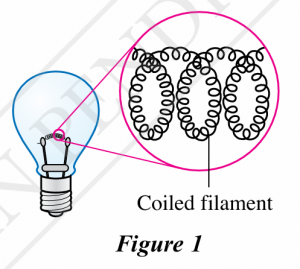
Answer:
– The filament lamps require high resistance to produce light.
– The coiled filament causes the wire length to increase.
– The resistance is directly proportional to the length of the wire.
– The longer the filament wire, the higher the resistance.
– The higher the resistance, the brighter the lamp.
Figure 1 shows a filament lamp. Why does a coiled filament produce a brighter light?
Answer:
– The filament lamps require high resistance to produce light.
– The coiled filament causes the wire length to increase.
– The resistance is directly proportional to the length of the wire.
– The longer the filament wire, the higher the resistance.
– The higher the resistance, the brighter the lamp.
Question 2:
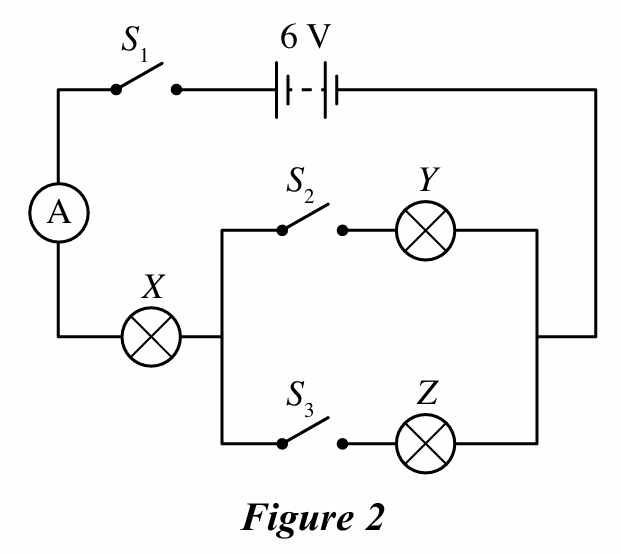 Figure 2 shows a circuit with three bulbs, X, Y and Z with a resistance of 3 Ω each.
(a) If switches S1 , S2 and S3 are closed, calculate:
(i) the effective resistance in the circuit
(ii) the current indicated by the ammeter
(iii) the potential difference across bulb X
(b) Compare the brightness of light bulbs X, Y and Z when switches S1, S2 and S3 are closed.
(c) If only switches S1 and S2 are closed, calculate:
(i) the effective resistance in the circuit
(ii) the current indicated by the ammeter
(iii) the potential difference across bulb X
(d) Compare the brightness of light bulbs X, Y and Z when only switches S1 and S2 are closed.
Answer:
(a)(i)
$$ \begin{aligned} &\text { Resistance, }\\ &\begin{aligned} \frac{1}{R} & =\frac{1}{3}+\frac{1}{3} \\ & =\frac{2}{3} \\ R & =\frac{3}{2} \\ & =1.5 \Omega \end{aligned} \end{aligned} $$
Effective resistance, R = 3 + 1.5
= 4.5 Ω
(a)(ii)
Potential difference, V = 6 V
Effective resistance, R = 4.5 Ω
$$ \begin{aligned} &\text { Current, } I =\frac{V}{R} \\ & =\frac{6}{4.5} \\ & =1.33 \mathrm{~A} \end{aligned} $$
(a)(iii)
Current, I = 1.33 A
Resistance, R = 3 Ω
Potential difference, V = IR
= 1.33 × 3
= 3.99 V
(b) Bulb X is the brightest compared to bulb Y and bulb Z. Bulb Y and bulb Z have the same brightness.
(c)(i)
Effective resistance, R = 3 + 3
= 6 Ω
(c)(ii)
Potential difference, V = 6 V
Effective resistance, R = 6 Ω
$$ \begin{aligned} &\text { Current, } I =\frac{V}{R} \\ & =\frac{6}{6} \\ & =1.0 \mathrm{~A} \end{aligned} $$
(c)(iii)
Current, I = 1.0 A
Resistance, R = 3 Ω
Potential difference, V = IR
= 1 × 3
= 3 V
(d) Bulb X and bulb Y glow with equal brightness. Bulb Z does not light up.
Figure 2 shows a circuit with three bulbs, X, Y and Z with a resistance of 3 Ω each.(a) If switches S1 , S2 and S3 are closed, calculate:
(i) the effective resistance in the circuit
(ii) the current indicated by the ammeter
(iii) the potential difference across bulb X
(b) Compare the brightness of light bulbs X, Y and Z when switches S1, S2 and S3 are closed.
(c) If only switches S1 and S2 are closed, calculate:
(i) the effective resistance in the circuit
(ii) the current indicated by the ammeter
(iii) the potential difference across bulb X
(d) Compare the brightness of light bulbs X, Y and Z when only switches S1 and S2 are closed.
Answer:
(a)(i)
$$ \begin{aligned} &\text { Resistance, }\\ &\begin{aligned} \frac{1}{R} & =\frac{1}{3}+\frac{1}{3} \\ & =\frac{2}{3} \\ R & =\frac{3}{2} \\ & =1.5 \Omega \end{aligned} \end{aligned} $$
Effective resistance, R = 3 + 1.5
= 4.5 Ω
(a)(ii)
Potential difference, V = 6 V
Effective resistance, R = 4.5 Ω
$$ \begin{aligned} &\text { Current, } I =\frac{V}{R} \\ & =\frac{6}{4.5} \\ & =1.33 \mathrm{~A} \end{aligned} $$
(a)(iii)
Current, I = 1.33 A
Resistance, R = 3 Ω
Potential difference, V = IR
= 1.33 × 3
= 3.99 V
(b) Bulb X is the brightest compared to bulb Y and bulb Z. Bulb Y and bulb Z have the same brightness.
(c)(i)
Effective resistance, R = 3 + 3
= 6 Ω
(c)(ii)
Potential difference, V = 6 V
Effective resistance, R = 6 Ω
$$ \begin{aligned} &\text { Current, } I =\frac{V}{R} \\ & =\frac{6}{6} \\ & =1.0 \mathrm{~A} \end{aligned} $$
(c)(iii)
Current, I = 1.0 A
Resistance, R = 3 Ω
Potential difference, V = IR
= 1 × 3
= 3 V
(d) Bulb X and bulb Y glow with equal brightness. Bulb Z does not light up.
Question 3:
An experiment is conducted to study the relationship between electromotive force, Ԑ and internal resistance, r of a dry cell. The electrical circuit for the experiment is shown in Figure 3. The voltmeter readings, V and the corresponding ammeter readings, I are as shown in Table 1.
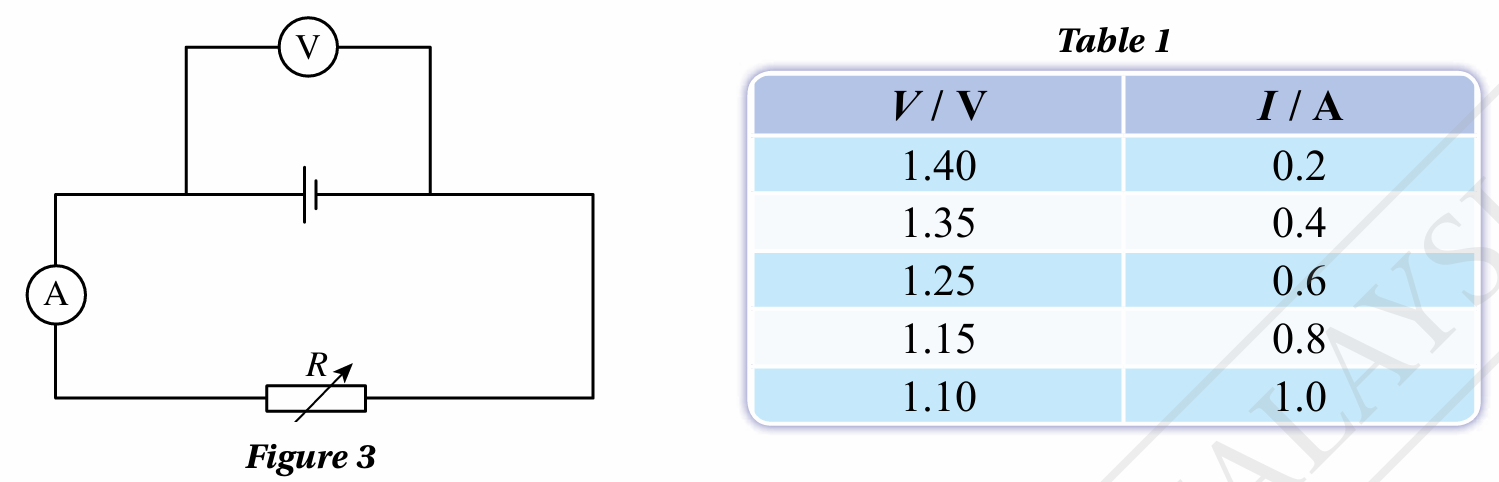
(a) What is meant by electromotive force?
(b) Based on the data in Table 1, plot a graph of V against I.
(c) Based on the graph plotted, answer the following questions:
(i) What happens to V when I increases?
(ii) Determine the value of the potential difference, V when the current, I = 0.0 A.
Show on the graph how you determine the value of V.
(iii) Name the physical quantity that represents the value in 3(c)(ii).
(d) The internal resistance, r of the dry cell is given by r = –m, where m is the gradient of the graph. Calculate r.
(e) State two precautions that need to be taken in this experiment.
Answer:
(a) The electromotive force, e.m.f. is the energy transferred or work done by a source of electrical energy to move one coulomb of charge in a complete circuit.
(b)
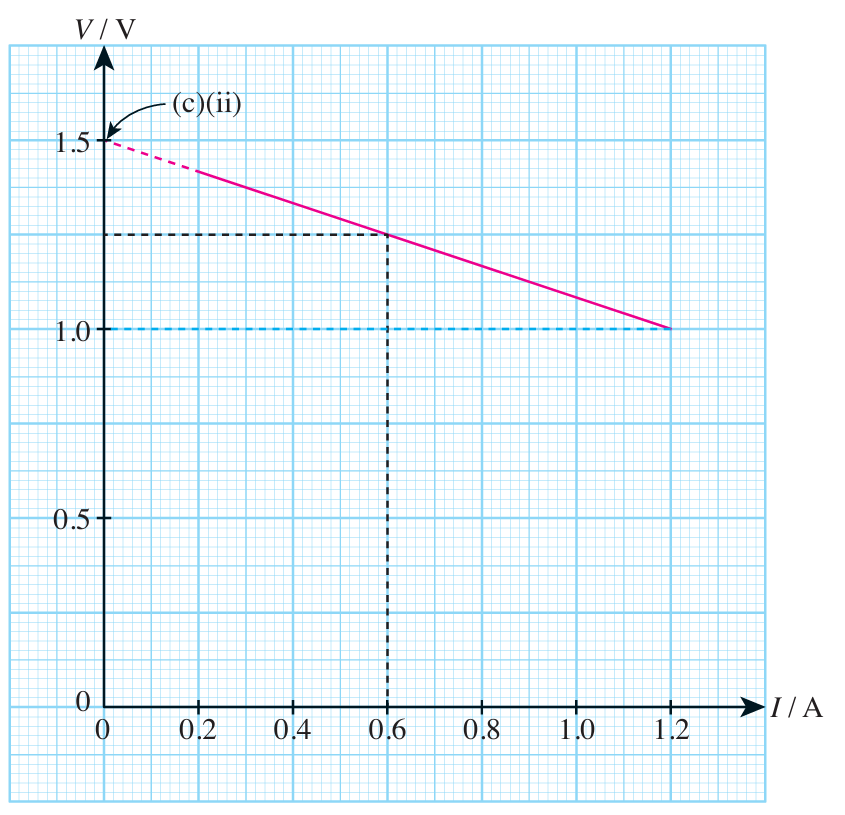
(c) (i) V decreases linearly with I
(ii) From the graph above, V = 1.5 V
(iii) Electromotive force, e.m.f.
(d)
$$ \begin{aligned} &\text { Gradient, } m =\frac{1.0-1.5}{1.2-0} \\ & =-0.417 \Omega \end{aligned} $$
$$ \begin{aligned} &\text { Internal resistance, } r =-m \\ & =-(-0.417) \\ & =0.417 \Omega \end{aligned} $$
(e) – Make sure the connecting wires are tightly connected.
– Avoid parallax errors when taking ammeter and voltmeter readings.
An experiment is conducted to study the relationship between electromotive force, Ԑ and internal resistance, r of a dry cell. The electrical circuit for the experiment is shown in Figure 3. The voltmeter readings, V and the corresponding ammeter readings, I are as shown in Table 1.
(a) What is meant by electromotive force?
(b) Based on the data in Table 1, plot a graph of V against I.
(c) Based on the graph plotted, answer the following questions:
(i) What happens to V when I increases?
(ii) Determine the value of the potential difference, V when the current, I = 0.0 A.
Show on the graph how you determine the value of V.
(iii) Name the physical quantity that represents the value in 3(c)(ii).
(d) The internal resistance, r of the dry cell is given by r = –m, where m is the gradient of the graph. Calculate r.
(e) State two precautions that need to be taken in this experiment.
Answer:
(a) The electromotive force, e.m.f. is the energy transferred or work done by a source of electrical energy to move one coulomb of charge in a complete circuit.
(b)
(c) (i) V decreases linearly with I
(ii) From the graph above, V = 1.5 V
(iii) Electromotive force, e.m.f.
(d)
$$ \begin{aligned} &\text { Gradient, } m =\frac{1.0-1.5}{1.2-0} \\ & =-0.417 \Omega \end{aligned} $$
$$ \begin{aligned} &\text { Internal resistance, } r =-m \\ & =-(-0.417) \\ & =0.417 \Omega \end{aligned} $$
(e) – Make sure the connecting wires are tightly connected.
– Avoid parallax errors when taking ammeter and voltmeter readings.