
Question 1:
Define current and potential difference.
Answer:
A current is the rate of flow of charge in a conductor.
The potential difference is the work done to move one coulomb of charge between two points.
Define current and potential difference.
Answer:
A current is the rate of flow of charge in a conductor.
The potential difference is the work done to move one coulomb of charge between two points.
Question 2:
What is an electric field?
Answer:
An electric field is the region around a charged particle where any electric charge in the region will experience an electric force.
What is an electric field?
Answer:
An electric field is the region around a charged particle where any electric charge in the region will experience an electric force.
Question 3:
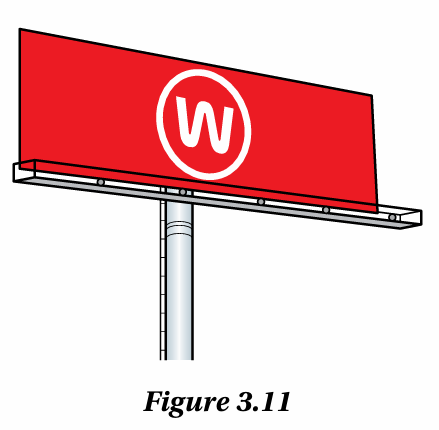
Figure 3.11 shows an electronic advertisement board. The current flowing is 4.0 × 10⁻² A. What is the number of electrons flowing in the circuit when it remains switched on for 3 hours?
Answer:
$$ \begin{aligned} & \text { Current, } I=4.0 \times 10^{-2} \mathrm{~A} \\ & \text { Time, } t=3 \mathrm{~h} \\ & \quad=3 \times 60 \times 60 \\ & \quad=10800 \mathrm{~s} \end{aligned} $$
$$ \begin{aligned} &\begin{aligned} & Q=n e \text { and } I t=n e \\ & 4.0 \times 10^{-2}(10800)=n\left(1.6 \times 10^{-19}\right) \end{aligned}\\ &\text { Number of electrons, } n=2.7 \times 10^{21} \text { electron } \end{aligned} $$
Figure 3.11 shows an electronic advertisement board. The current flowing is 4.0 × 10⁻² A. What is the number of electrons flowing in the circuit when it remains switched on for 3 hours?
Answer:
$$ \begin{aligned} & \text { Current, } I=4.0 \times 10^{-2} \mathrm{~A} \\ & \text { Time, } t=3 \mathrm{~h} \\ & \quad=3 \times 60 \times 60 \\ & \quad=10800 \mathrm{~s} \end{aligned} $$
$$ \begin{aligned} &\begin{aligned} & Q=n e \text { and } I t=n e \\ & 4.0 \times 10^{-2}(10800)=n\left(1.6 \times 10^{-19}\right) \end{aligned}\\ &\text { Number of electrons, } n=2.7 \times 10^{21} \text { electron } \end{aligned} $$
Question 4:
A bulb labelled 3.0 V, 0.2 A was lit for 1 hour. Calculate:
(a) the electric charge
(b) the energy generated
Answer:
(a)
Time, t = 1 × 3 600
= 3 600 s
Current, I = 0.2 A
Charge flow, Q = It
= 0.2 × 3 600
= 720 C
(b)
Potential difference, V = 3.0 V
Charge flow, Q = 720 C
Energy, E = VQ
= 3.0 × 720
= 2 160 J
A bulb labelled 3.0 V, 0.2 A was lit for 1 hour. Calculate:
(a) the electric charge
(b) the energy generated
Answer:
(a)
Time, t = 1 × 3 600
= 3 600 s
Current, I = 0.2 A
Charge flow, Q = It
= 0.2 × 3 600
= 720 C
(b)
Potential difference, V = 3.0 V
Charge flow, Q = 720 C
Energy, E = VQ
= 3.0 × 720
= 2 160 J
Question 5:
An electric charge of 900 C flows through a metallic conductor in 10 minutes. Calculate the current.
Answer:
$$ \begin{aligned} & \text { Charge flow, } Q=900 \mathrm{C} \\ & \text { Time, } t=10 \mathrm{~min} \\ & =10 \times 60 \\ & =600 \mathrm{~s} \\ & \text { Current, } I=\frac{Q}{t} \\ & =\frac{900}{600} \\ & =1.5 \mathrm{~A} \end{aligned} $$
An electric charge of 900 C flows through a metallic conductor in 10 minutes. Calculate the current.
Answer:
$$ \begin{aligned} & \text { Charge flow, } Q=900 \mathrm{C} \\ & \text { Time, } t=10 \mathrm{~min} \\ & =10 \times 60 \\ & =600 \mathrm{~s} \\ & \text { Current, } I=\frac{Q}{t} \\ & =\frac{900}{600} \\ & =1.5 \mathrm{~A} \end{aligned} $$